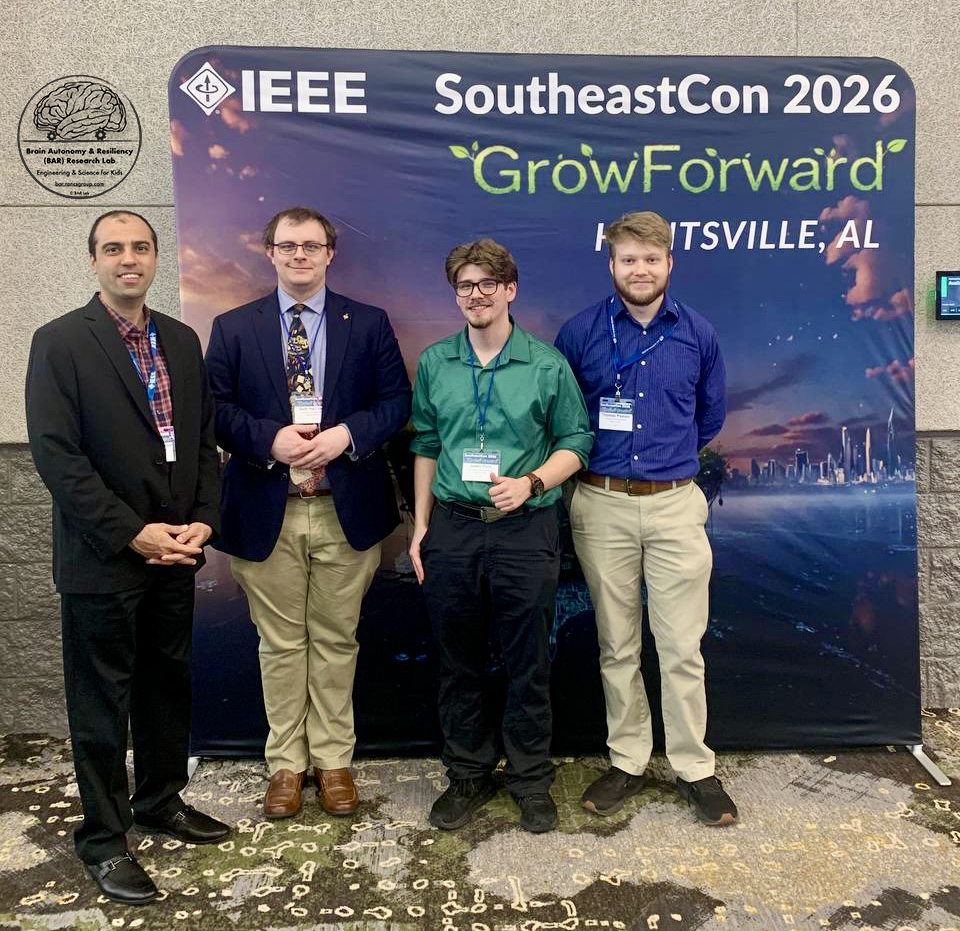
The Brain Autonomy and Resiliency (BAR) Lab is proud to highlight the recent publication of two peer-reviewed research papers presented at the IEEE SoutheastCon 2026 conference in Huntsville, Alabama. Led by Dr. Saman Sargolzaei, associate professor of engineering, the work reflects the lab’s continued commitment to advancing intelligent systems, human-centered autonomy, and sustainable technologies.
The BAR Lab team, including undergraduate researchers Justin Finn, Thomas Paxton, Jesse Warren, Arden Stanley, Seth Hatchett, Connor Viana, and collaborators from interdisciplinary fields, actively contributed to the conference through paper presentations, technical session leadership, and participation in software, circuit design, and ethics competitions.
Advancing Sustainable Agriculture with Autonomous Systems
The first paper, “Autonomous Ground Vehicle for Precision Weed Detection and Targeted Pesticide Spraying Using Deep Learning,” presents an innovative approach to precision agriculture. The research introduces an AI-powered autonomous ground vehicle that integrates LiDAR-based navigation with a real-time computer vision system using the YOLO deep learning framework.
This system enables accurate detection and classification of weeds in real time, followed by targeted pesticide application. By limiting chemical use strictly to identified weed regions, the platform significantly reduces environmental impact, lowers operational costs, and promotes sustainable farming practices. Experimental results demonstrate strong performance in object detection accuracy and system feasibility in real-world agricultural settings.
Understanding Cognitive Load in Autonomous Driving
In collaboration with Resilient Autonomous Networked Control Systems (RANCS) Lab, The second paper, “Assessment of Driver Cognitive Load in Autonomous Driving Using Extended Reality Simulation,” explores how advanced driver assistance systems (ADAS) influence human cognitive load. Using an extended reality (XR) driving simulator, the study integrates EEG, heart rate variability (HRV), and eye-tracking data to evaluate driver responses under different driving conditions.
Findings suggest that fully autonomous driving and AI-assisted steering reduce cognitive load, as evidenced by changes in neural activity and physiological signals. In contrast, manual driving and AI-assisted throttle showed less significant impact. This work provides important insights into the design of safer and more effective human-autonomy interaction systems.
A Collaborative and Interdisciplinary Effort
Both projects highlight the BAR Lab’s interdisciplinary approach, bringing together expertise in engineering, computer science, biology, agriculture, and human factors. Collaborators included faculty and students from multiple departments, as well as external partners.
These publications underscore the BAR Lab’s mission to develop intelligent, resilient systems that enhance human performance while addressing real-world challenges in transportation, agriculture, and beyond.
Both papers are now accessible through IEEE Xplore.
https://ieeexplore.ieee.org/document/11476058
https://ieeexplore.ieee.org/document/11475990
