
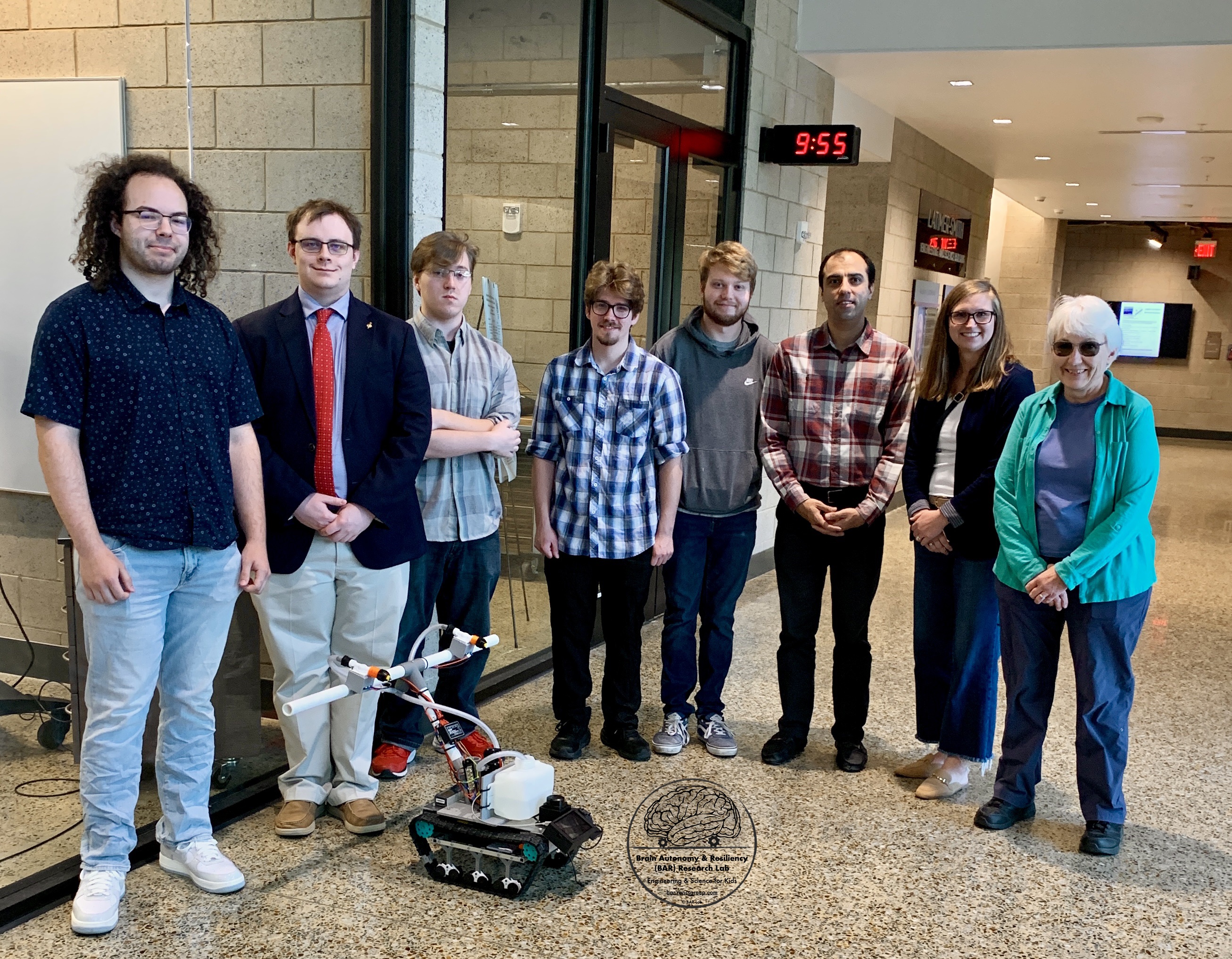
The Brain Autonomy and Resiliency (BAR) Lab is breaking new ground in sustainable agriculture with a project that combines robotics, artificial intelligence, and environmental responsibility.
Sponsored by the Tennessee Corn Promotion Board (TCPB), The lab recently developed an autonomous ground vehicle for precision weed detection and targeted pesticide spraying, addressing a major challenge in modern agriculture. Traditional blanket pesticide application not only increases chemical usage and operational costs but also impacts the environment. The BAR Lab’s system aims to make weed management more efficient, accurate, and sustainable.
The autonomous vehicle integrates perception, navigation, and actuation within a single platform. It uses a LiDAR sensor to navigate uneven agricultural terrain autonomously while a camera-based vision system, powered by the YOLO (You Only Look Once) deep learning framework, detects and classifies weeds in real time.
As the vehicle moves along a field, it continuously captures images and identifies weed species with high accuracy. The system then localizes the weeds spatially and triggers a precision spraying mechanism, ensuring that pesticides are applied only where needed. Early experimental results demonstrate the system’s ability to reduce unnecessary chemical use while maintaining effective weed control.
“By combining deep learning with autonomous vehicles, we can make agriculture more efficient and environmentally responsible,” says Dr. Saman Sargolzaei, director of the BAR Lab. “This project shows how robotics and AI can directly contribute to sustainability while reducing operational costs for farmers.”
The project represents a collaborative effort of faculty and student researchers, integrating expertise in robotics, computer vision, and control systems. The system was evaluated using standard performance metrics such as mean Average Precision (mAP) and Intersection over Union (IoU) to ensure reliable and accurate weed detection.
With this work, the BAR Lab is helping pave the way for next-generation agricultural technologies that are not only intelligent and autonomous but also environmentally conscious. This project demonstrates the lab’s commitment to developing practical, real-world solutions at the intersection of technology and sustainability.
